Working with an agent
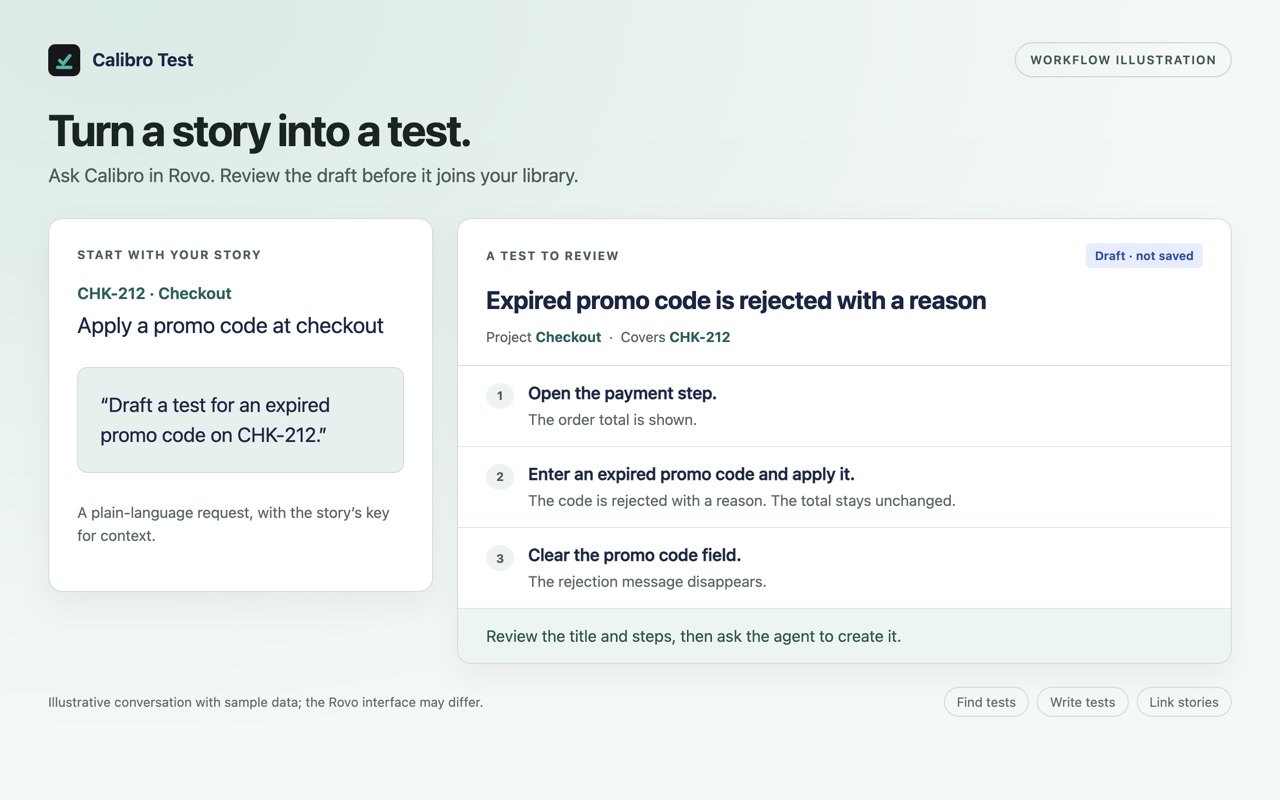
Calibro Test ships its own Rovo agent. Press Ask Calibro at the top of the app and Rovo chat opens on the Calibro Test Agent; or open Ask Rovo anywhere in Jira and switch to it. Then say what you want in plain language — write a test for this story, what tests cover CHK-212, find the tests that have never been run, add a step to T219.
Ask Calibro
The button opens the agent directly, so you never have to find it in Rovo's list. It shows when Rovo is available on your site and hides when it isn't. The agent is the way in: Rovo's default agent does not carry these tools, ours does.
What it can do
Twelve tools, each one the same thing the app's own screens do:
Creating a test from chat is the same as creating one in the editor: it gets a key, it goes in the library, and if you were on a story it covers that story and the story's field follows it. Everything you have open — the library in another tab, the Tests panel — updates the moment the agent writes, with no refresh.
The rules it follows
- It runs as you. Every tool acts under your own Jira permissions and the app's licence; if you couldn't do it on the page, the agent can't either.
- It shows the title and steps before creating a test, and Rovo asks before any tool writes.
- It confirms before deleting a test or unlinking a story.
- It reads a test before changing its steps, because steps given replace all of them.
- It never invents an expected result you did not describe. If a step's outcome is unclear, it asks.
Your own agent in Rovo Studio
Teams that build their own agents in Rovo Studio can add the same twelve tools under Connected apps and write their own instructions around them — a release agent that lists what's uncovered in a fix version, say. The tools are the same, and so are the rules: they run as the person talking, and a mutating tool is refused while the app's subscription is inactive.
What an agent cannot do
Record a run. Walking the steps and deciding each one is a person's job, and there is no tool for it on purpose. Nor can an agent set the Test coverage field — only runs move it. Automation rules cannot call a tool that writes. And clients outside Rovo — Claude Code, Cursor, Codex — wait on Atlassian opening app tools to them; it is on the roadmap, and nothing here changes when it lands.