Test cases for Jira, with coverage you can filter on.
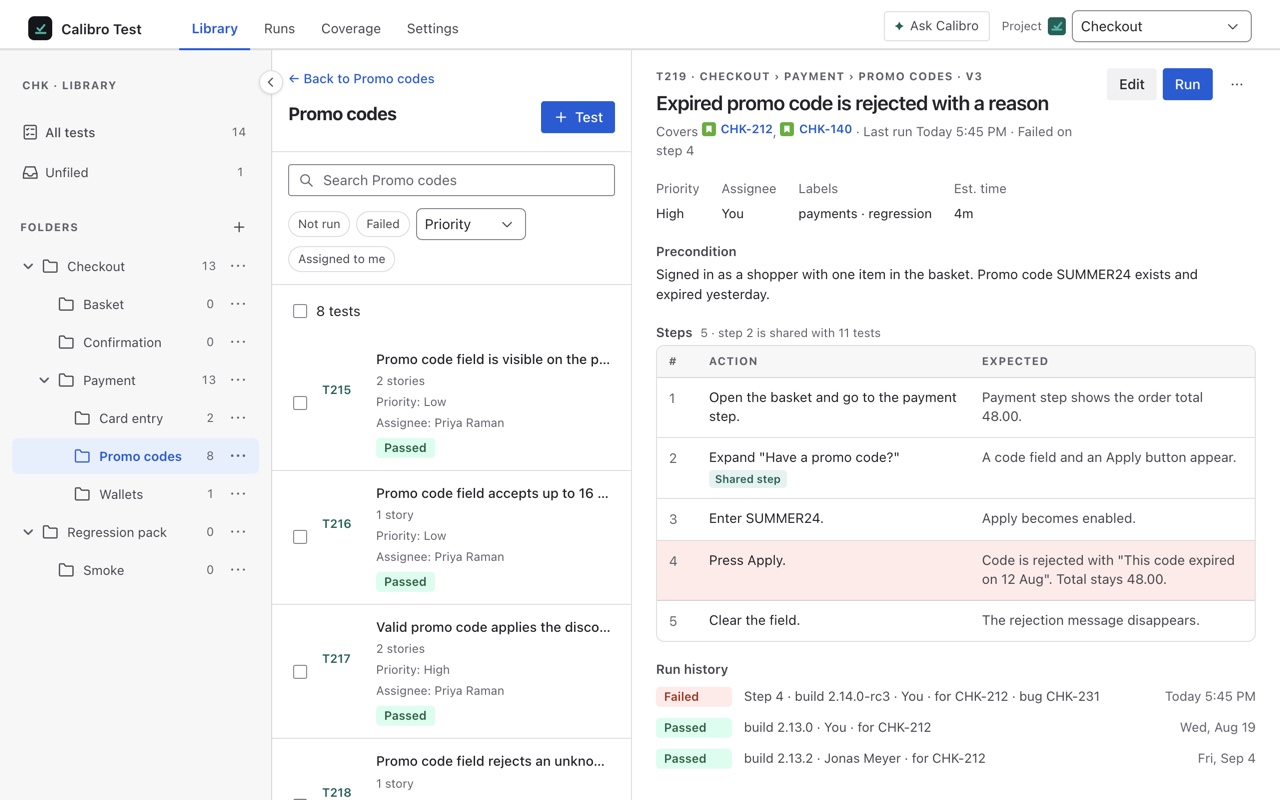
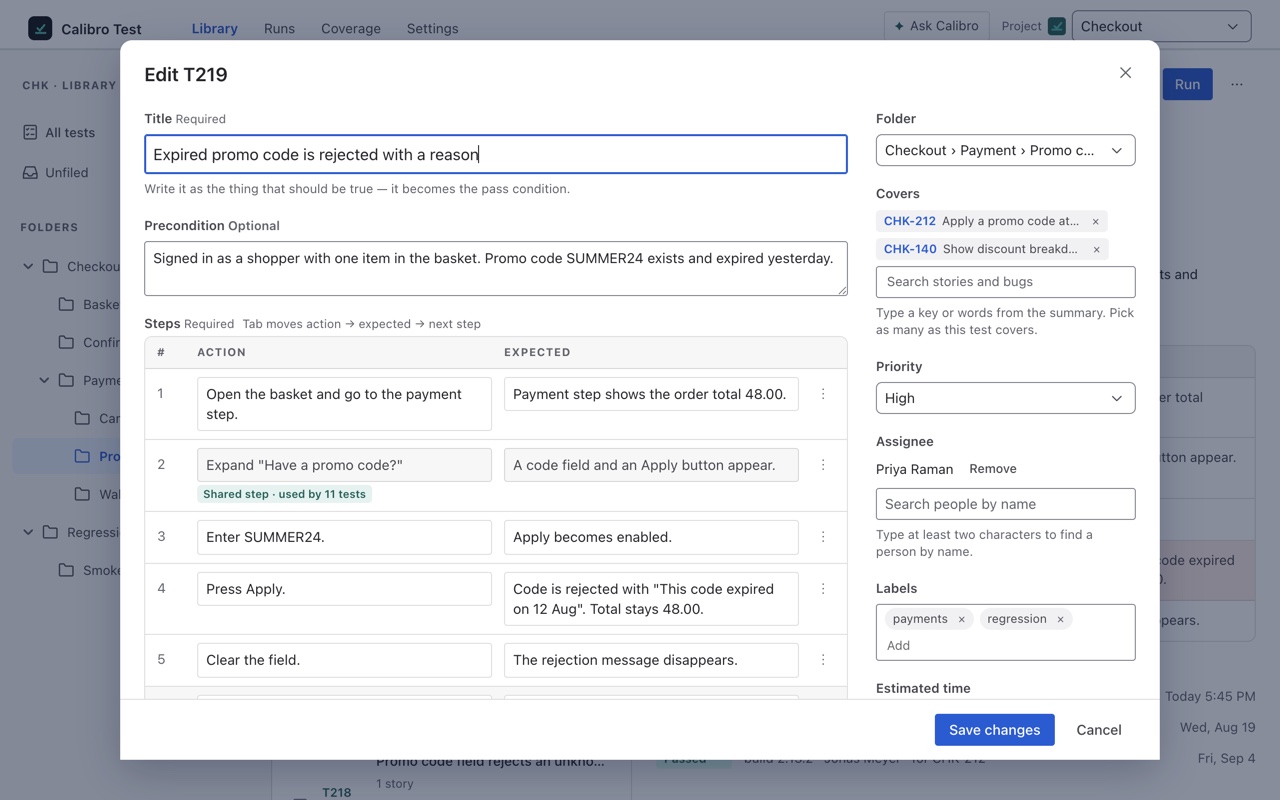
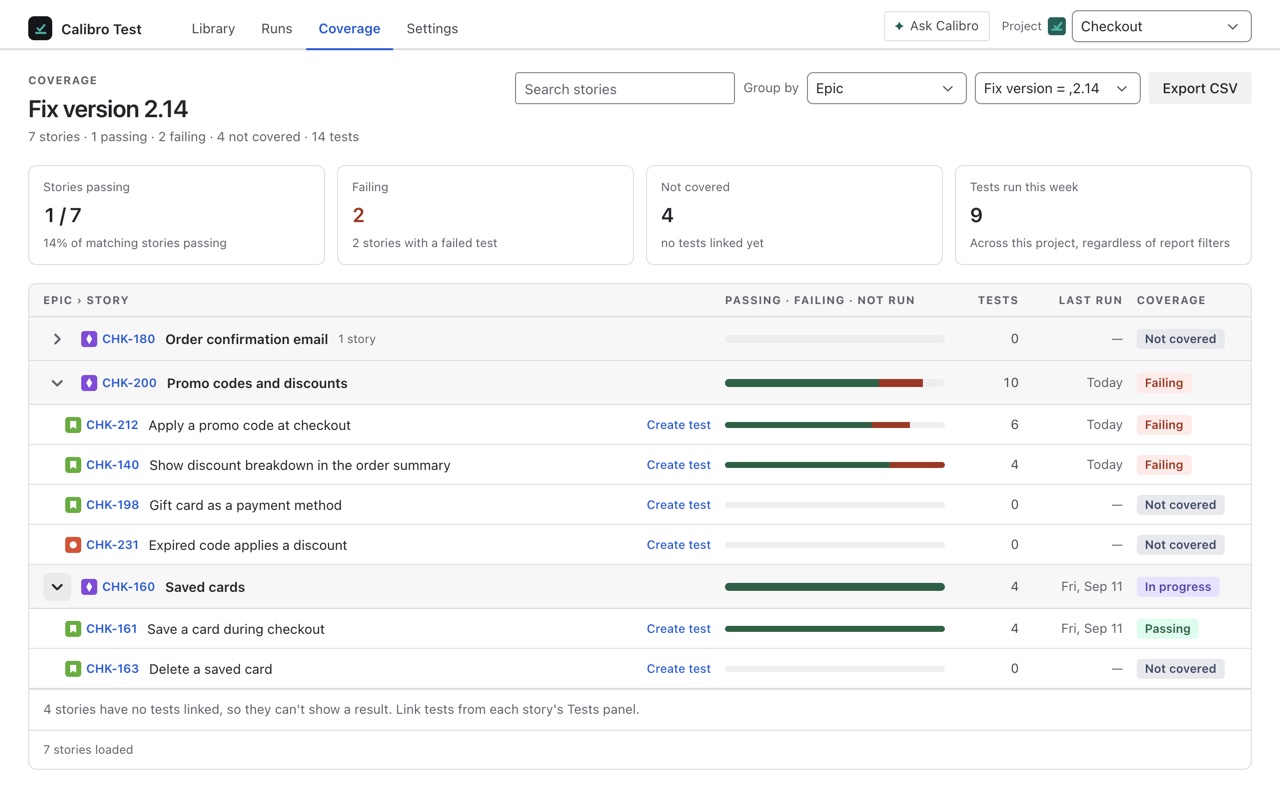
A library of tests with steps, runs of them one step at a time with a bug filed from the step that failed, and a Test coverage verdict on every story that is a real Jira field. "Test coverage" = Failing works in JQL, saved filters and board swimlanes, so nobody has to open a report to find out. Tests are never issues, runs are never work logs, and nothing leaves your Jira site.
Free for up to 10 users, then US$1.20 per user per month — less as your site grows. And your tests stay inside your Jira site.
New Calibro Test now speaks German, Spanish, French and Portuguese (Brazil) — each person in their own Atlassian language, nothing to set up. What's new →
Screenshots show the real app with sample data. The Ask Calibro slide is a workflow illustration.
Coverage is a field, not a report
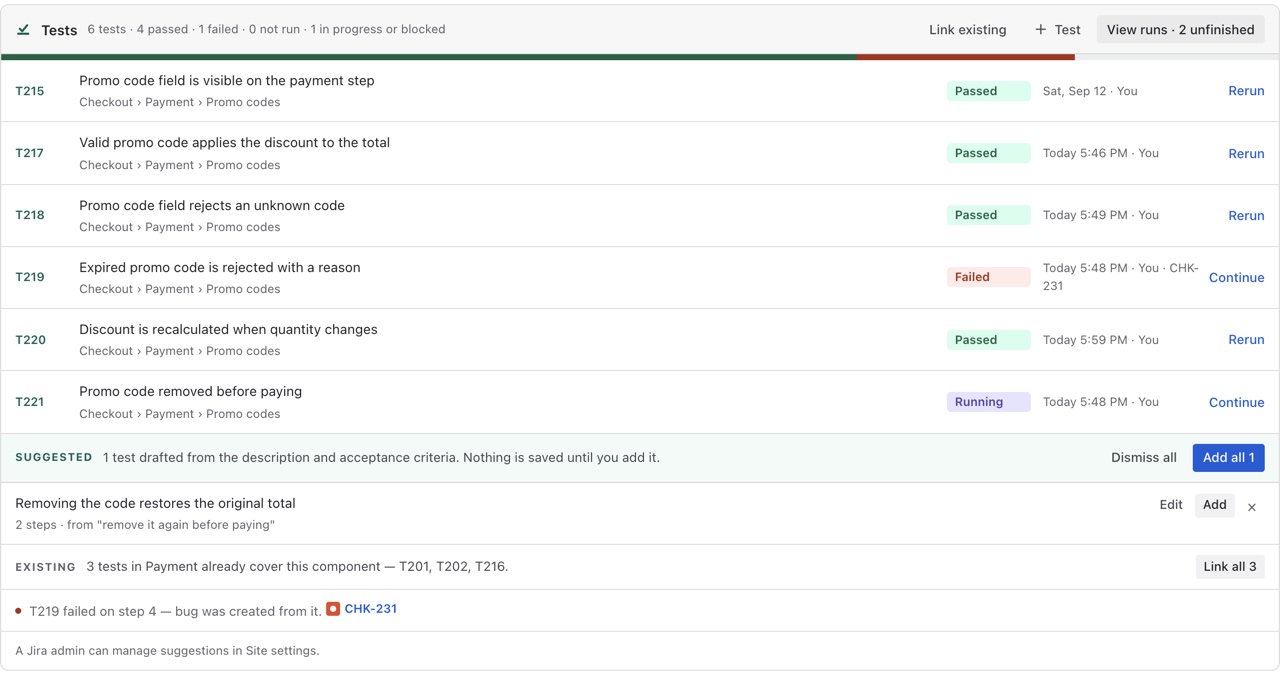
Every story carries a Test coverage field — a real Jira custom field the app keeps in sync after every change that can move it. Five values: Passing, Failing, In progress, Not run, Not covered. Filter on it, put it in a swimlane, count it on a dashboard. The field is read-only, so it always says what the runs say and never what somebody typed.
Tests are ours; your issues stay yours
A test is a row in the app's own database on your site, never a Jira issue, and a run is never a work log. There is no issue type to add, no scheme to configure, and nothing of ours turns up in Jira search. The only things that reach Jira are the coverage field and the bug you choose to file.
A failing step is a verdict
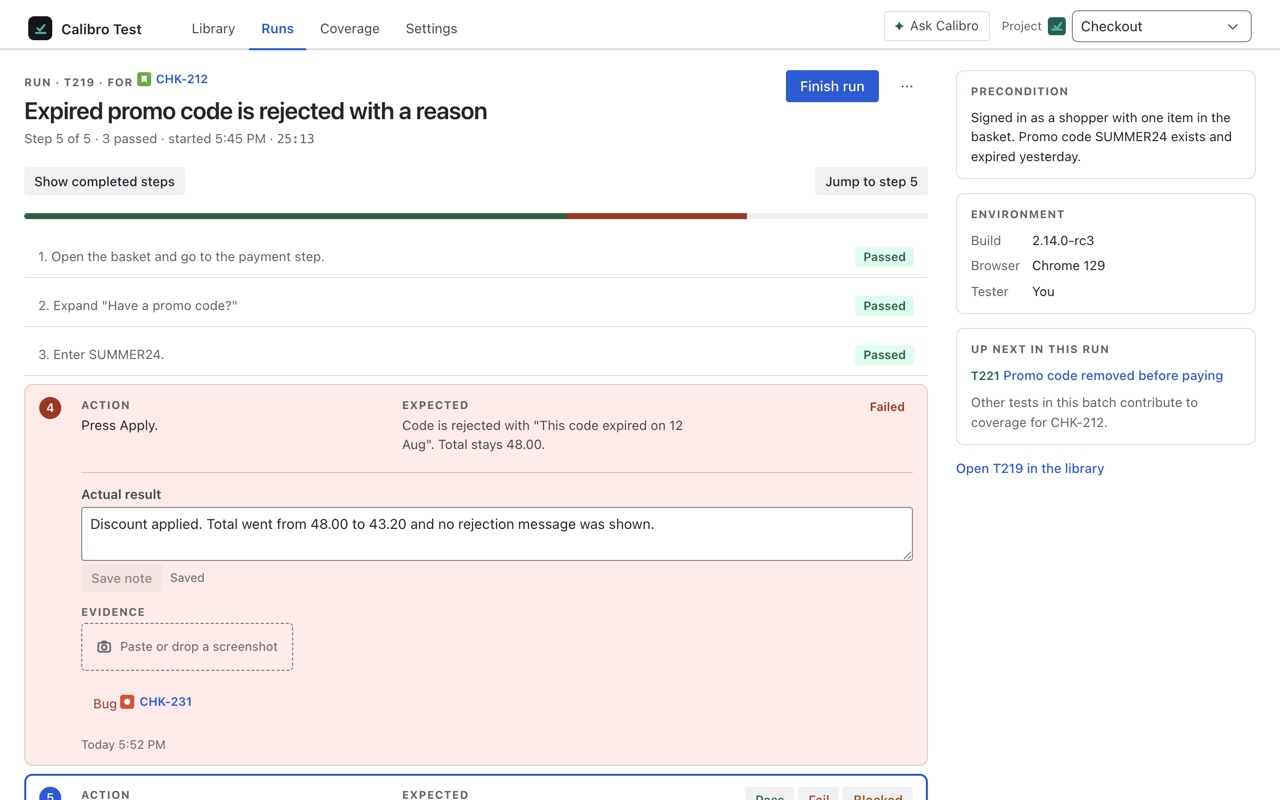
The moment a step fails, the run is failed and the story turns red — not when somebody presses Finish. A later pass never undoes it, and a run finished with steps unrun is recorded as blocked, never as passed. A verdict the steps don't support is the one thing a coverage field must not say.
The bug is filed from the step
Paste a screenshot onto the failing step and it lands on the story as an ordinary attachment. Create bug files a Bug in the project pre-filled with the steps so far, the expected and actual result and the evidence, and links it back to the story and the run. The tester never retypes what the run already knows.
Drafts from the story
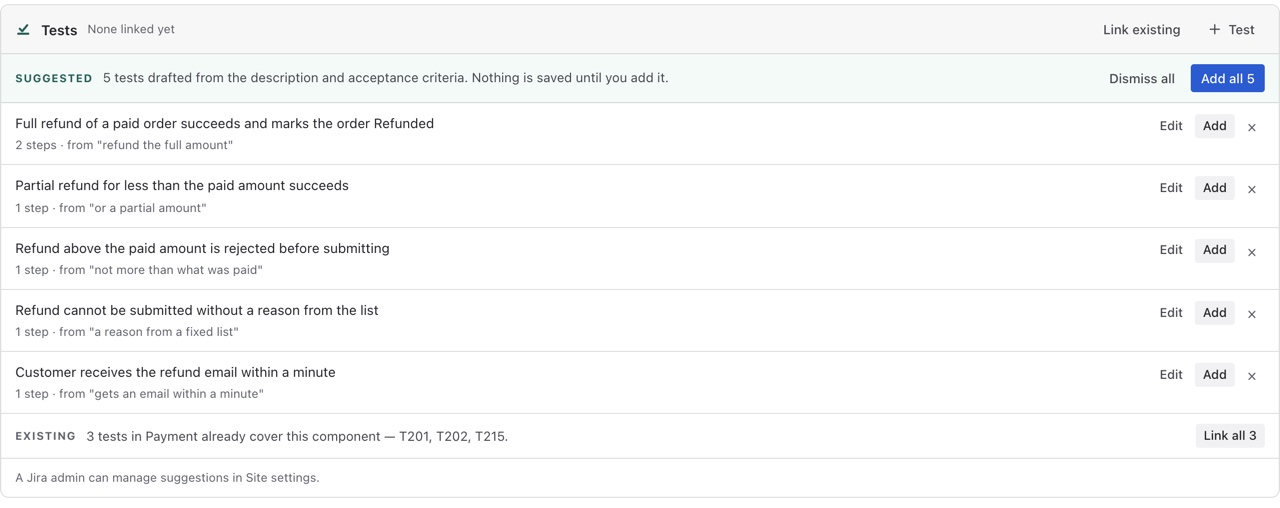
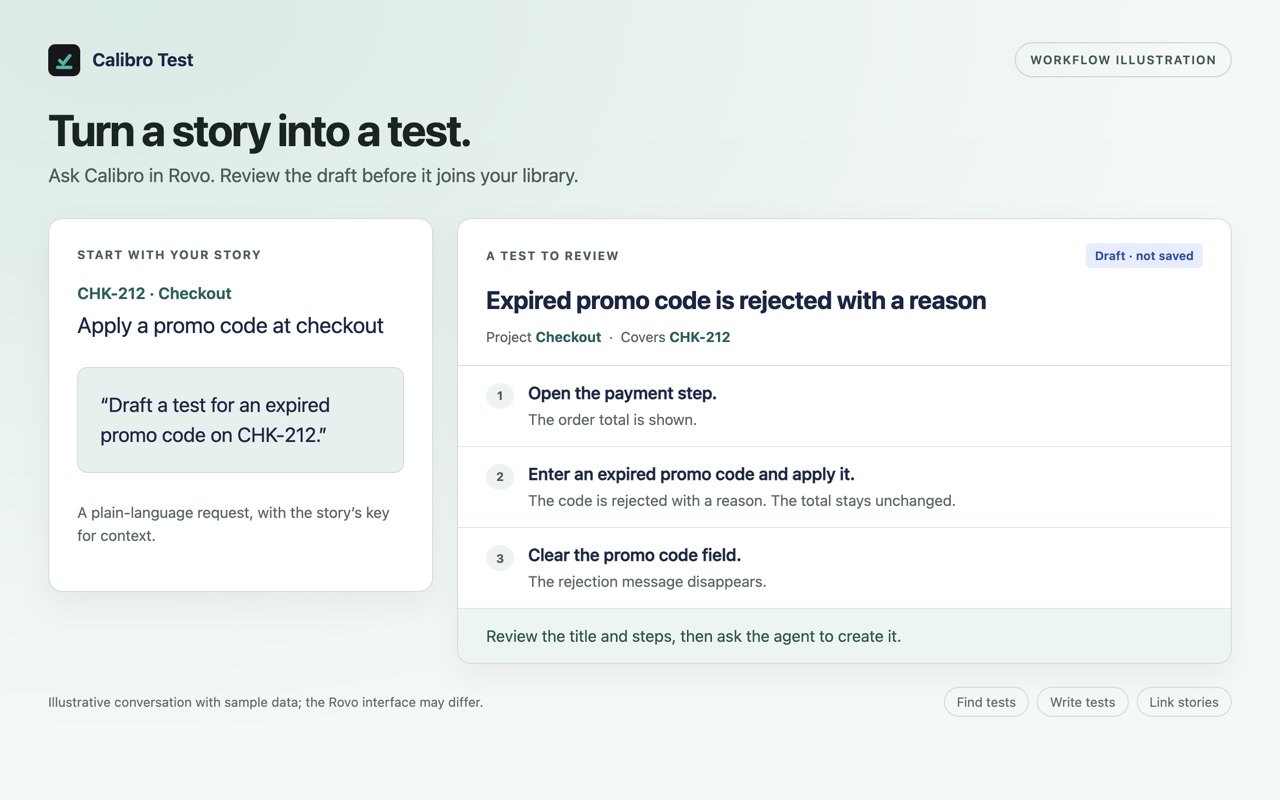
A story with nothing linked yet gets tests drafted from its description and acceptance criteria, each one pointing at the sentence it came from. They are drafts until somebody adds one — nothing is saved, a dismissal sticks, and a site admin can turn the whole thing off. Drafted by Atlassian-hosted Claude, so the story text never leaves Atlassian.
Nothing leaves your site — AI and agents included
Built entirely on Atlassian Forge, like Track, Sketch, Pulse, Explore, Prioritize and Plan. Tests and runs are stored and processed inside Atlassian's infrastructure, the suggestions run on Atlassian-hosted models through the Forge LLMs API, and the app's tools for agents — press Ask Calibro, or add them to your own agent in Rovo Studio — run as you, under your own Jira permissions. The app declares no external egress at all.
Pricing that fits in one sentence.
Free for up to 10 users. From the 11th, US$1.20 per user per month, and the rate steps down automatically as your site grows. Annual billing costs less again. Billed by Atlassian alongside Jira; the whole app on every plan, the coverage field and the drafts included.
Stop paying and your tests and runs stay readable — the field keeps its last value and nothing is held hostage. The Marketplace listing always shows the current price, and the pricing page has the detail.
What it does, it does properly.
Calibro Test is on the Atlassian Marketplace now, built around one idea carried all the way through: coverage should be a field you already filter on, not a report you open. Everything else follows from that.
A test is a row of ours, never an issue, so nothing of the app's turns up in your backlog. A failing step is a verdict the moment it lands, and the bug is filed from that step with everything the run already knows. And the story's field is read-only, so it only ever says what the runs say.
What we would most like to hear is whether a verdict that lives on the story — in JQL, in a swimlane, on a dashboard — changes who looks at test results. That is the whole bet, and it is not one we can settle by ourselves.
What works today
Install it and see.
Installs from the Marketplace like any Jira app. Uninstalling removes it cleanly, and takes its data with it.